


Late Fall 1202 AL
Lightning split the heavens, and thunder boomed instantly. The compact freighter, Alikuna, revealed in the split-second flash of light, reeled on the churning sea as her captain strove to keep her bow pointed into the waves. Her headsail in tatters, she climbed shudderingly out of a trough, creaking as she pitched forward, sheets of water spilling off her empty deck.
The soaking, frigid winter night had sapped the strength and will of her crew of young sailors from the tropical Summer Isles. Their thin coats, canvas pants, and inadequate shoes were no match for the bitter cold of an Osegran winter, even off the normally temperate southwestern coast of Margonne. The furious storm they faced, unexpectedly barreling out of the west, had made their plight all the worse. Other than the captain, whose kit included woolen clothing and rain gear, all but one had fled below decks, manning the pumps and praying to their warmer gods.
Between the seemingly incessant lightning strikes, the night hung black around them, and the driving rain completed the blinding of the captain. As each bolt of lightning stabbed at the sea, he tried to catch a glimpse of the craggy coast, which he assumed lay somewhere to starboard, but to no avail. With numbed fingers and hands, he steered Alikuna into the teeth of the westerly gale, hoping his course lay far enough south to keep the ship off the rocks.
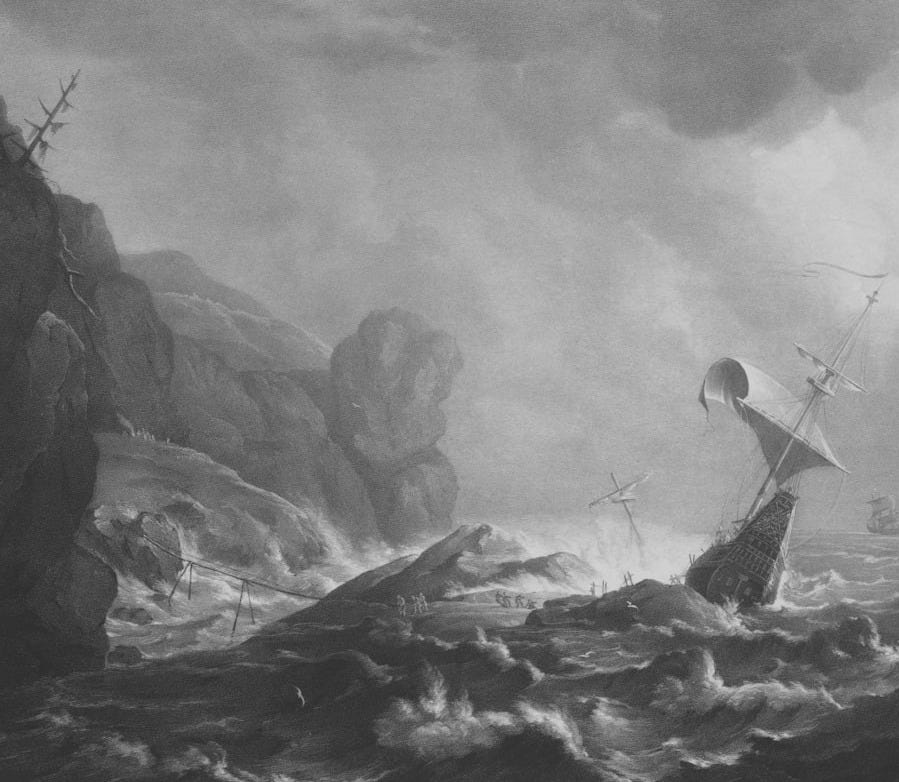
An experienced mariner with a proud Neva Island lineage, the captain had sailed these waters many times. He knew their dangers. Even so, he had never attempted rounding Sea Lion Cape in the dead of night during a raging storm. The cape was perilous enough on its own with the meeting of the Western and Southern Oceans and the jagged rocks that lay in wait just a few fathoms beneath his keel.
If he had not had mounting debts, he would have declined taking on the illicit cargo and the urgent dash to Haimar. He knew the dangers of a nighttime run around the cape in late autumn, but the premium payment he had been promised—three times the standard rate—persuaded him to take the risky trip. If I had the same decision now, he groaned inwardly, I would refuse, to hellfire with my debts! The costs were already too high, having sacrificed at least one unlucky seaman to the storm’s fury, not to mention the damage to his ship.
In his defense, he had been unaware of the storm’s approach. The previous morning, the skies were sunny and clear over the remote cove on the southern coast of Neva Island where the cargo transfer had occurred. At sunset, the sky had darkened, foregoing any semblance of twilight. It worried him, but he had committed to a strict timeline, so he continued under the fitful light of a sliver of a moon through building clouds. Though the seas built into the evening, his frame of mind turned to dread only when the gale struck just before midnight.
He futilely wiped water from his eyes, shouting curses at the storm. To himself, he cursed his greed and foolishness. Scowling, he cursed the seller and his agent and himself again for not asking more questions. He had no idea what his hold contained, only that his contact had mentioned it was rare and exotic, “playthings for a Haimarian official who will pay handsomely for swift delivery.” Alikuna’s captain cursed the Haimarian official, too, before sending another wail heavenward, seeking mercy from his god.
Terror gripped his gut with a gauntleted fist. He knew he had never strayed closer to death than during this interminable night. The squall howled like a wailing spirit prophesying of a yawning watery grave, and hearing it, he felt his doom drawing him down into the depths.
Lightning flashed and boomed again, and the lingering veins of light suddenly revealed cliffs to starboard, far closer than he thought they could be. He tried to swing the bow to port, to point it out to sea, but he had little control with the remnants of the jib hanging uselessly. Doubting that his ship was making any headway, he feverishly imagined that the storm was instead driving it irretrievably to its destruction.
He shouted for the lone sailor on deck with him. The man could not have heard what he yelled at him, but he understood his captain needed him to take the wheel. By hand signs and pointing off the port bow, the captain tried to tell the sailor to steer the ship a few points south of west. The soaked and shivering islander nodded and took the unresponsive helm.
The captain pulled himself down to the main deck, never letting go of a handhold before finding another. Rounding the foot of the stairs, he groped his way to his cabin’s door and, only with supreme effort, opened it enough to stumble inside., Though now protected from wind and rain, he still had to clutch at his desk and then his table, both solidly affixed to the floor, to make his sodden way across his quarters.
His destination lay at the end of his bunk: his sea chest. He would not abandon ship without his most cherished possessions, especially his coins. The gold might be heavy, but he could not imagine surviving this night only to live like a beggar until he could get back on his feet. If he strapped his sealskin bag across his back, his few irreplaceable things would not be too much of a hindrance.
Then, as the ship pitched again, he remembered the mysterious box handed to him just before the seller’s agent had disembarked from the Alikuna. It was only a little more than a foot wide and about half again as wide and tall, and weighed very little. The man had said, “Whatever happens, make sure this box gets delivered. You won’t get paid if it’s missing.” He had turned and left before the captain thought to ask what it contained. I doubt the man would have answered me if I had.
In a minute, he had the locked box trussed with a length of rope and tied to his back, joining the bag. Satisfied with how little the two packages weighed, he had taken only a step toward the door when a wave struck the starboard bow quarter with stunning force, canting the ship dangerously and turning it to take the next wave amidships, nearly rolling her over.
Hurrying, he retraced his steps, but the going was harder with the ship pitching and yawing like an inebriate on an icy road. The storm’s wind felt more biting, the deck under his feet slicker. Immediately, his hands numbed again, and his feet felt like blocks of ice. He reached the steps to the quarterdeck when Alikuna reeled again, and he lost his tenuous grip on the newel post.
Only the opposite banister saved him from being swept overboard. He struck it with his hip, and the momentary pause in his progress was time enough for him to clutch the rail with both arms. With the lethargy of the aged, the ship righted itself only to take the brunt of the next swell, now striking the starboard bow. As the captain clawed his way up the steps, it crossed his mind that the sailor at the helm had, by luck or heretofore untapped skill, miraculously recovered the correct heading.
In that instant, another shaft of lightning split the air, striking and exploding the mainmast, flinging splinters in every direction. The captain, hunched over with his back to the mast, escaped unscathed, but the sailor at the helm proved not so fortunate. A sharp, foot-long splinter skewered his neck, and the next wave, washing over the deck, tilted his body over the side.
Paralyzed for a long moment, the captain stared at the empty space behind the wheel, uncomprehending. Another wave splashed him to his senses, and he laboriously pulled himself onto the quarterdeck. Reaching the wheel, he threw himself onto it, stopping its mad spinning. He looked around to get his bearings, but he could see nothing until another bolt of lightning illuminated the night.
The cape’s unforgiving cliffs towered over Alikuna.
He had no time to panic. Alikuna’s keel scraped on rock, causing the ship to shudder and slow. The next swell lifted her off, but its trough sent her crashing down on another submerged boulder, punching a cart-sized hole in her hull. The sea flooded in, and she began to list, wallowing as wave and wind buffeted her, driving her deeper into the rocks. Before long, she had settled on the bottom, and the storm, with unrelenting ferocity, pounded her from stem to stern, breaking her apart.
The crew spilled out onto the deck, screaming questions at the captain. Still clutching the wheel, he turned it mechanically, unheeding. One sailor reached him, shaking him out of his stupor and shouting repeatedly, “What should we do?”
After the fourth or fifth time, the captain finally heard him. He looked at the young man with bleak, bloodshot eyes. “Abandon ship,” he said without raising his voice. “Give yourselves to the sea. Maybe you will live.”
“But there is no boat!” the sailor wailed.
The captain shook his head. It had been one of the first casualties of the storm, ripped away more than an hour before. He did not bother to answer.
He thought about the time-honored tradition of a captain going down with his ship, but he rejected the idea. If Alikuna were in the middle of the ocean, he could see the logic, but they could swim to land from here, if they could avoid being dashed upon the jagged rocks. Someone might make it, he thought, sighing. I will have to lead them once more.
Turning, he clambered slowly down to the canted deck, sliding down its slick surface to the port rail. He put a leg over it, then the other, sitting on it only for a moment. Then, as another bolt of lightning rent the night, he jumped into the unruly sea.
*****
Before dawn, the squall passed into the east. Day broke gray and wet, and the sea returned to its usual rhythms. By midmorning, sunlight lifted the gloom. Coastal birds soared about in their perpetual search for food, and occasionally, sea lions could be heard bawling down the coast.
A ship’s carcass lay on its side amidst a scattering of rugged rocks. Bits of its cargo had lodged themselves in hollows and crevices here and there or floated on the water, drifting with the tide. A closer inspection would discover the mangled bodies of men flung by the waves against the rocks, some as far as the narrow beach at the base of the cliff.
One body, lying on its stomach in the rocky sand, differed from the others. On the dead man’s back, a box had been tied, but it was now battered and broken in several places, though still whole enough to secure its contents.
The angry sea had peeled away a strip of wood about two inches wide, and through that gap, the contents of the box could be glimpsed: two chalky white eggs with a colorful swirling pattern flowing across their surfaces, one in yellow and the other in orange. Both were intact and warming in the sun.
A note:
Haimar is a long, narrow country along Osegra’s southwestern coast. Its capital city is the port of Basmah, which lies in the central region. The geography is mostly mountainous, except for a narrow coastal plain that runs its length, and it boasts few natural resources. The nation is ruled by an oligarchy of tribal chiefs, led by a Great Chief whom they elect from among themselves. The Great Chief has little actual power, as local governments are quite autonomous—except in the rare times of war, when the people expect the Great Chief to lead them in battle. Rarely has Haimar been truly united, and civil war between the regions is a constant threat. A significant difficulty is that the northern tribes are predominantly matriarchal, while the southern ones tend to be patriarchal. Adding to the confusion, tribes in its central region have experimented with a simple form of democracy, electing their chiefs by popular vote. Thus, crippled by its internal squabbles, it remains a weak nation.


Thanks for reading! If you enjoyed this post, please hit the ❤️ below, restack, and share it with your friends. Also, please consider buying me a cup of coffee!
Wow! What a start to the story! And, of course, it leaves us hanging.
I'm invested already! Parts of this reminded me a little of The Wager by David Grann (really good book).